South Korea’s data center industry is going through a quiet recalibration. Growth today has less to do with capital or demand and more to do with capability, and the market’s greatest constraint is no longer whether facilities get built, it’s whether anyone experienced is available to run them.
The signal is already flashing across the industry. The market is projected to grow at a 21.5% CAGR through 2030, and 58.8% of national capacity still sits within the Seoul Metropolitan Area, an area now running up against power, land and grid limits. As new projects push into regional markets to solve that constraint, employers relying on traditional hiring models are increasingly losing the experienced professionals who matter most, right at the location and compensation stage.
So what’s really going on beneath the surface?
The Takeaway
South Korea’s data center employers aren’t losing the talent war because good engineers don’t exist. Korea has a genuinely strong technical workforce built on semiconductors, telecommunications, utilities and advanced manufacturing. They’re losing it because the pool of professionals with direct, end to end mission critical data center experience remains small, and because new regional projects are asking Seoul based talent to relocate to places the industry hasn’t historically operated in.
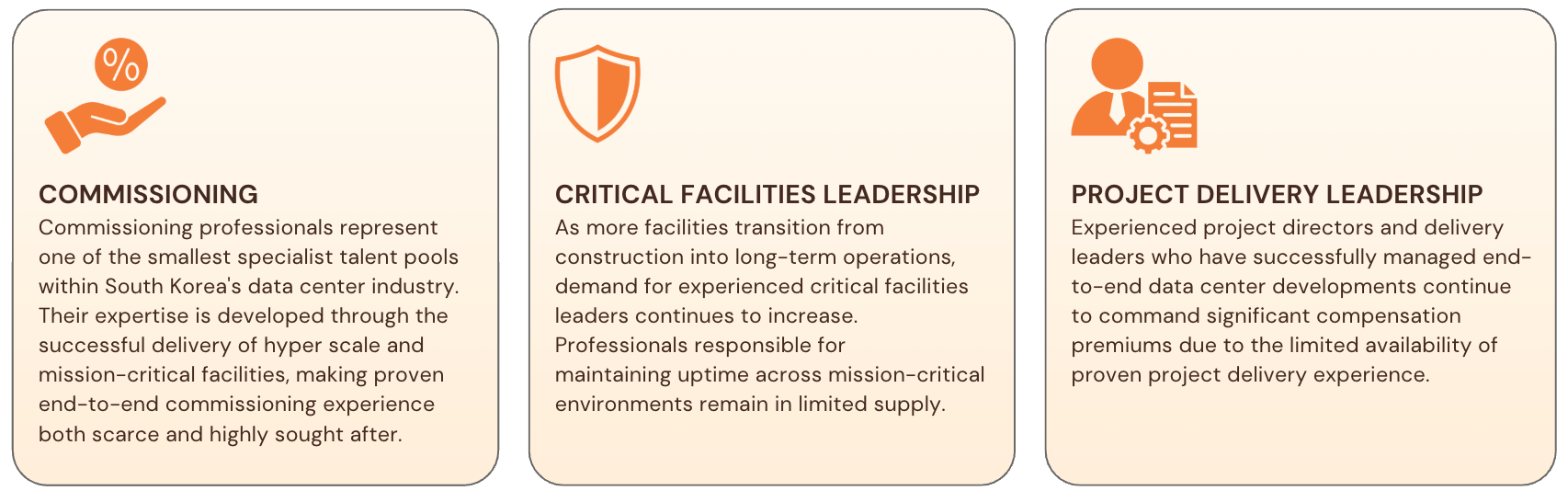
Specialist Talent Pool – Very High Hiring Difficulty
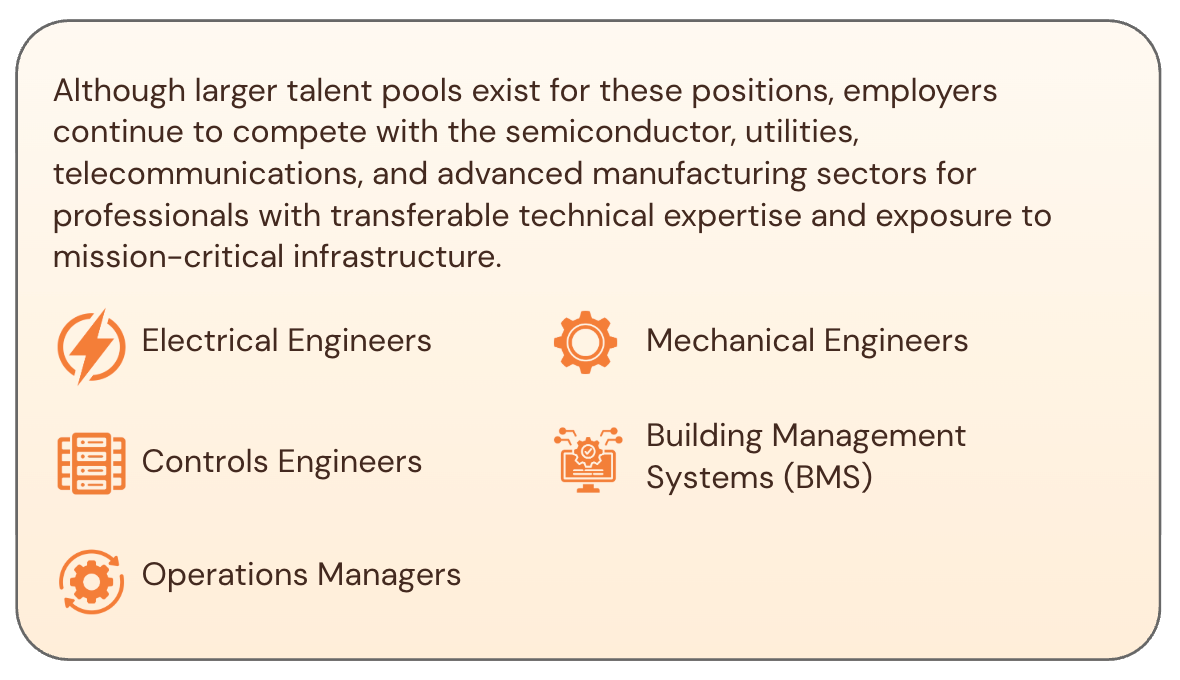
Technical Infrastructure – High Hiring Difficulty
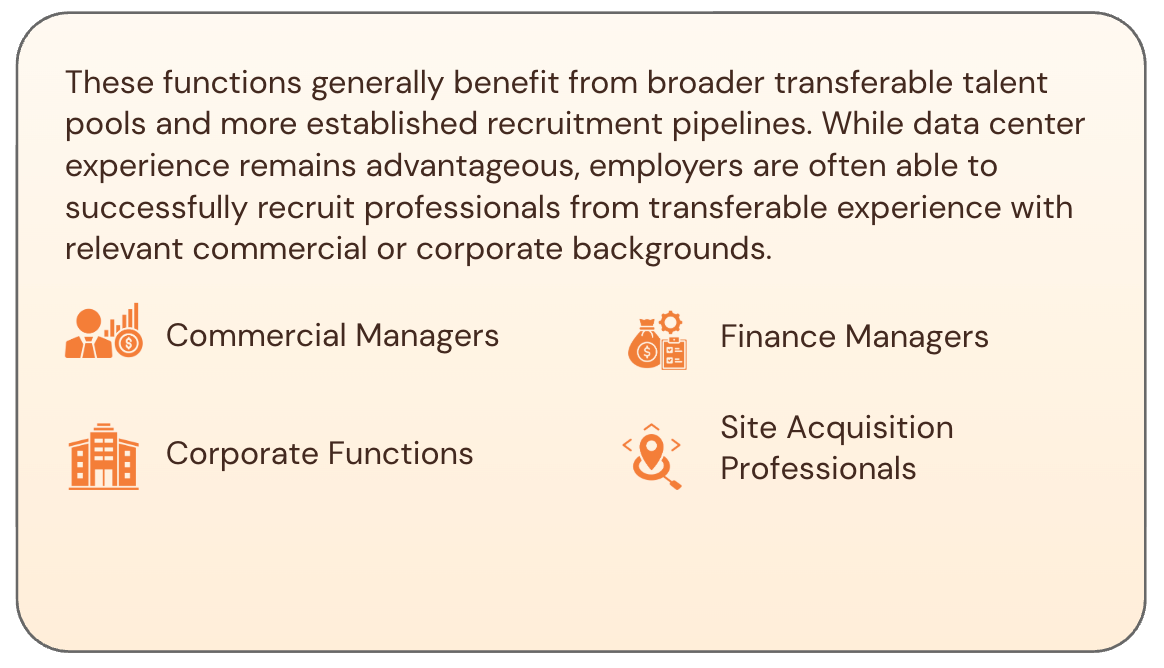
Corporate & Commercial – Moderate Hiring Difficulty
What Employers Should Do
- Recruit from adjacent industries deliberately, not opportunistically. The report identifies specific, proven pathways: EPC, oil & gas, industrial construction, and power generation for build-out roles; power generation, telecoms, semiconductor manufacturing, and advanced manufacturing for operations roles. Employers still writing job descriptions that require “3+ years data center experience” are filtering out exactly the professionals most likely to succeed in the role. Rewriting requirements around transferable technical exposure, not sector-specific tenure, is what actually opens up the candidate pool.
- Front-load the conversations that cause late-stage rejections. The report is explicit that most lost offers aren’t about candidate scarcity, they’re about misalignment on compensation, location, and shift expectations that surfaces too late in the process. For roles outside the Seoul Metropolitan Area especially, commuting distance and relocation terms need to be on the table in the first conversation, not disclosed after a candidate has mentally accepted. The same applies to shift work: candidates weighing a 24/7/365 operations role need to see how compensation and career progression reflect that demand upfront, not discover it during negotiation.
- Match the compensation strategy to the role, not the org chart. Project delivery leadership can be won with milestone-based incentives and completion bonuses. Operations roles can’t, they run on fixed pay, shift allowances and predictable progression, so employers trying to close operations hires with one-time bonuses are solving the wrong problem. As the report notes, compensation alone is becoming a weaker differentiator as market benchmarks mature. What’s replacing it is credible signals of organizational stability and technical growth, particularly for new market entrants who need to convince experienced candidates they’re not walking into a project that stalls.To discuss how HRnetOne Korea can support your workforce agenda in the data center sector, reach out to our team directly.

Ricky SEO 서동호 | Associate Consultant | ricky.seo@hrnetone.com