2026 Deep Dive: Data Center Development Trends in Singapore
 Catherine Yeow - Group Business Leader, HRnetOne Singapore & Thailand
Posted On 24 August 2026
Catherine Yeow - Group Business Leader, HRnetOne Singapore & Thailand
Posted On 24 August 2026

Singapore’s data center market isn’t short of money. AWS has committed SGD 12 billion, Google USD 5 billion, and Digital Realty S$7 billion, and none of that capital is what’s actually slowing growth down. What’s gating the market now is execution: whether an operator can clear a steadily tightening approval bar, and whether it can staff what gets approved once it clears it.
The numbers make the squeeze obvious. Singapore’s 1.4 GW of operating capacity already sits on just 278 square miles of land under a hard power ceiling, and the newest approval round, DC-CFA2, cleared barely 200 MW against roughly 500 MW of demand that went unmet. Operators are answering by building across the Causeway in Johor instead of on the island, and employers still hiring the way they did five years ago are watching candidates walk at the final stage, right when pay and sponsorship terms come up.
So why does that keep happening?
The Takeaway
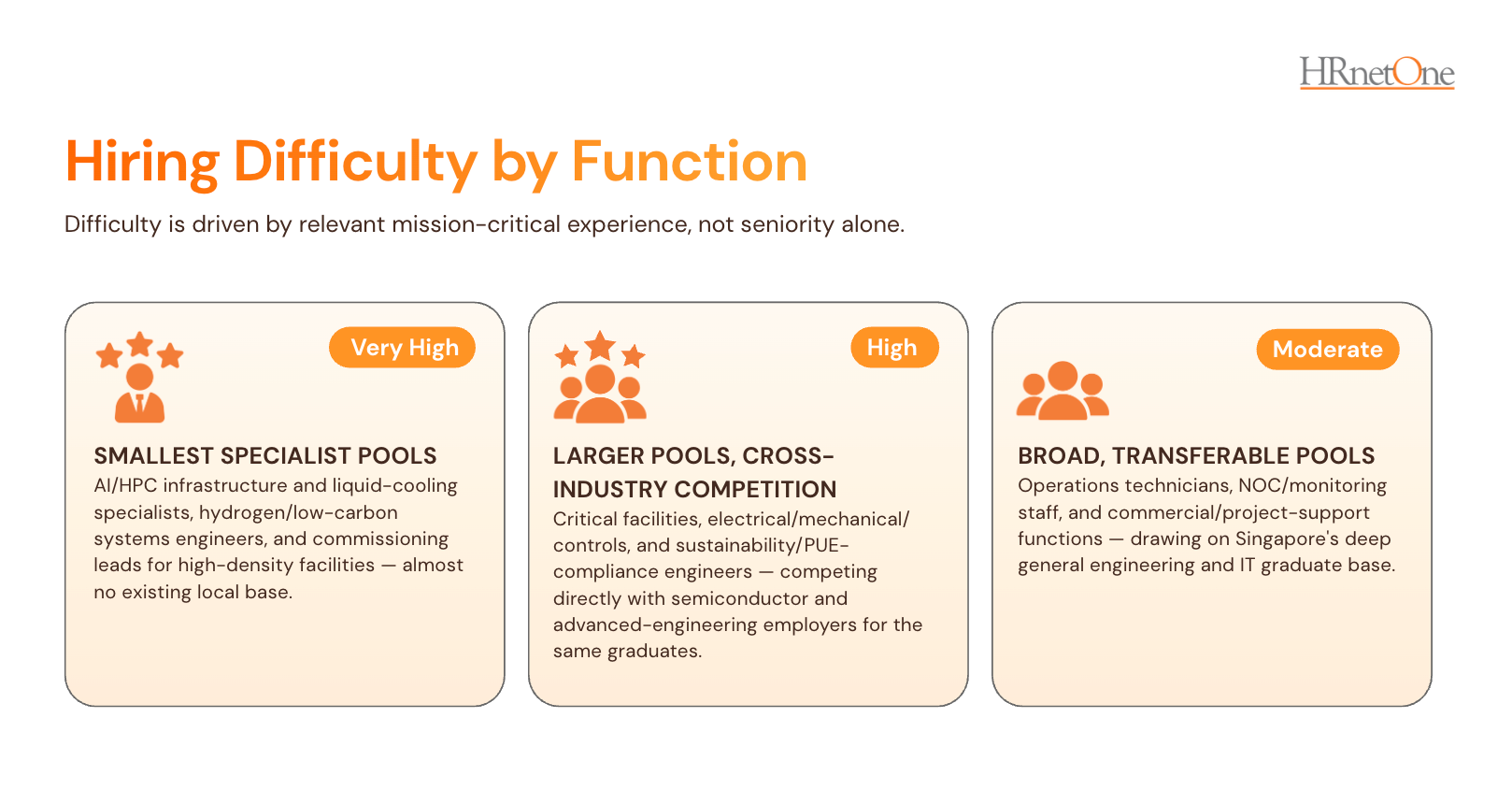
This isn’t a talent drought. Singapore’s semiconductor, telecom, utilities and advanced manufacturing sectors have produced a deep bench of qualified engineers for decades. The real problem is narrower: almost nobody has hands-on experience with liquid cooling, hydrogen and ammonia power systems, or AI infrastructure at the density DC-CFA2 now demands, because these requirements barely existed three years ago. And even where that experience exists, data centers aren’t winning the bidding war for it. Finance, fintech and semiconductor employers routinely pay more for the identical skill set.
What Employers Should Do
- Stop requiring “data center experience” and start recruiting the industries that already do this work. Jurong Island’s oil and gas and petrochemical firms, industrial EPC contractors, and power generation and utilities companies have spent decades running safety-critical, mission-critical builds, exactly the discipline a build-out role needs. On the operations side, semiconductor manufacturers, telcos and precision manufacturers already run 24/7 uptime-critical environments. A job posting demanding prior data center tenure screens out commissioning engineers and critical facilities specialists who could ramp up fast. Screen for the underlying discipline, not the industry label on a resume.
- Put the hard conversations first, not last. Most offers that fall apart in Singapore don’t fail because the candidate wasn’t interested, they fail because compensation, sponsorship terms or a Johor-based commute only came up once the candidate was already deep into the process. If a role sits on the Johor side of the twin-hub model, say so, and lay out the commute and relocation terms in the first call. If a candidate is weighing your offer against a fintech firm that can simply pay more, show them the whole package early, sponsorship stability, training investment, a real career track, not a number that only tells half the story.
- Retain sponsored specialists and local hires with different tools, because they respond to different things. For Employment Pass and S Pass holders, restarting the sponsorship clock is a real cost of switching jobs, so a stable, well-run sponsorship process is worth more to them than most employers realize. Local hires don’t feel that friction, they’re weighing career progression and access to training instead. Treating both groups the same, usually with a pay bump, misses what keeps either of them around. And with finance, fintech and semiconductor firms now matching or beating data center pay outright, salary alone is a shrinking lever anyway. What’s left to compete on is real investment in scarce-skill training and a genuine cross-border career path across the Singapore-Johor corridor.
Want to talk through what this means for your hiring plans in Singapore’s data center sector? Reach out to our team directly.
Catherine YEOW 姚佩玲 | Managing Director | catherine@hrnetone.com