South Korea became a super-aged society in 2025, with one in five people now 65 or older. Demand for healthcare is rising fast. But the companies trying to deliver that care are caught in a structural squeeze: a chronic shortage of clinical talent on one side, and tighter government pricing controls on the other.
The result is a healthcare talent market that looks nothing like it did even three years ago.
THE NUMBERS THAT MATTER
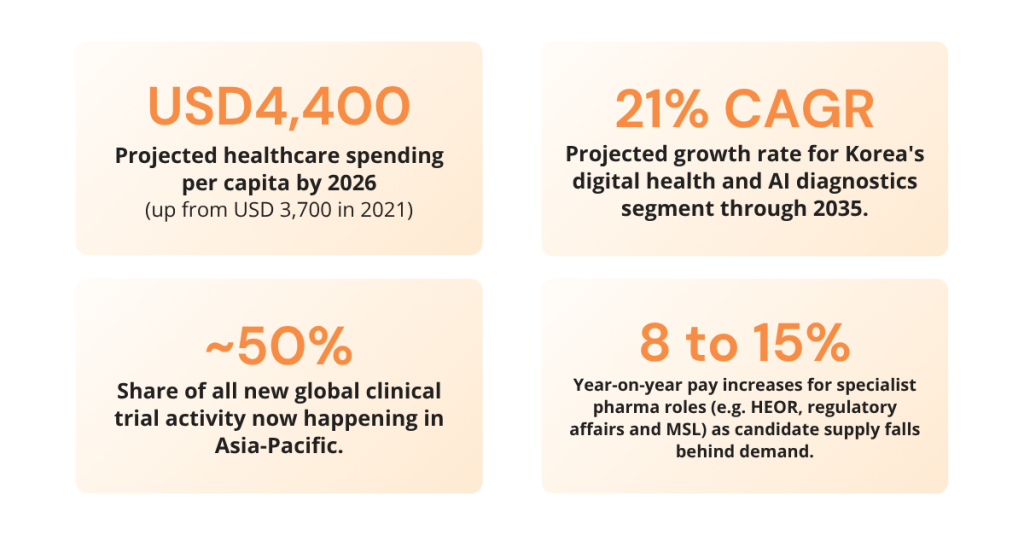
Behind these figures is a sector pulling in different directions at once. Reimbursement reform has made large in-house pharma commercial teams harder to justify, pushing experienced, well-trained talent out into the open market. Medical device and equipment companies are absorbing much of that talent, helped by steady hospital procurement and a commercial story that isn’t tied to a single product’s pricing cycle. Market expansion service providers, who take over promotion and distribution work that pharma companies used to do themselves, are picking up the rest.
For candidates, the calculus has changed too. Job security now matters more than upside. Predictable pay matters more than a big bonus that depends on hitting targets that keep getting harder to hit. And increasingly, people want to know their work actually leads somewhere, to a patient outcome, a surgical result, a diagnosis that lands faster.
The employers winning the talent conversation right now aren’t necessarily the biggest names. They’re the ones who’ve understood that shift and built their hiring approach around it.
KEY TAKEAWAYS
- The best pharma talent isn’t underperforming, it’s exiting. Mid-career commercial professionals with 5 to 12 years of multinational experience are leaving shrinking pharma teams, not because they failed, but because the ceiling is getting lower. That’s a sourcing opportunity for medtech and market expansion employers, if they move first.
- Stability is now a selling point, not a given. Candidates are vetting employers before they vet the role, asking whether a company is growing or shrinking in Korea. A job description that doesn’t address this directly will lose strong candidates to one that does.
- Clinical credibility can come from outside the industry. OR nurses, biomedical engineers and physiotherapists with the right exposure often translate into medical device roles better than commercial hires without clinical grounding. Widening the sourcing pool matters more than widening the job posting.
- Compensation structure is shifting, not just compensation amount. Candidates are pushing back on variable-heavy packages that worked three years ago. A solid base and transparent bonus mechanics now close more offers than a higher theoretical ceiling.
To discuss how HRnetOne Korea can support your workforce agenda in the Healthcare sector, reach out to our team directly.
Dianne Yang | Practice Leader | diannewy.yang@hrnetone.com